

By Cory McPherson
July 31, 2026
With interest rates climbing in an uptrend for most of this year, while the Federal Reserve has been on pause the last several months on interest rate policy, it appears the bond market has been doing the work for the Fed. While it has suppressed bond prices, it has not had a major effect on the broad stock market yet. What we have seen in the last two months in the market, though, is an unwind in some of the semiconductor and A.I. stocks that had a big move in April and May. In this newsletter I’ll review some charts on interest rates I’m watching, as well as what the unwind in semiconductors looks like so far.
While we’ve seen inflation readings rise this year due to shocks in the oil and gas markets, the Federal Reserve has not responded by raising their benchmark interest rate yet. Price stability is one of the mandates for the Fed and this year they have let inflation run hot. Obviously, much of this year’s inflation goes back to oil and gas. If things somehow stabilize in the Middle East and oil and gas prices come down, the belief is overall inflation will follow. If not, we could certainly see the Fed take action in raising rates. They held their July meeting this week and yet again kept their benchmark rate the same, although with a few dissents arguing for a rate hike. Odds have been shifting that the Fed will act before the end of the year and raise rates.
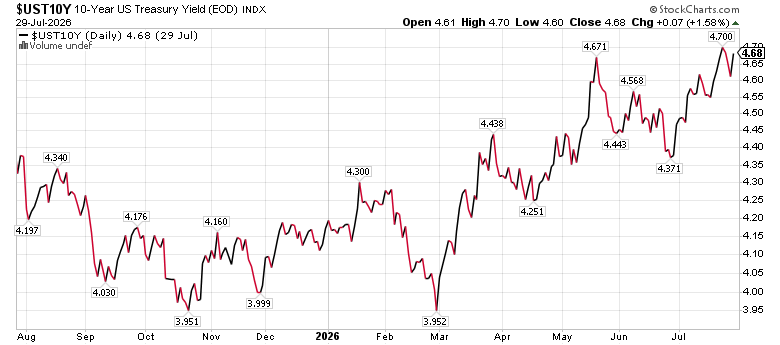
I’ve highlighted in past newsletters how the 10-year treasury rate affects corporate debt, consumer borrowing costs, mortgage rates, and even stock market valuations. As you can see from the chart below, the 10-year rate has been trending higher since the end of last year. It has gone from nearly 3.9% in late February and peaking last week at over 4.7%. There can multiple reasons for interest rates to move higher including inflation and expectations of inflation in the future. It can also be a simple supply/demand issue, with this being a sign of less demand for U.S. treasuries and higher rates needed to attract buyers.
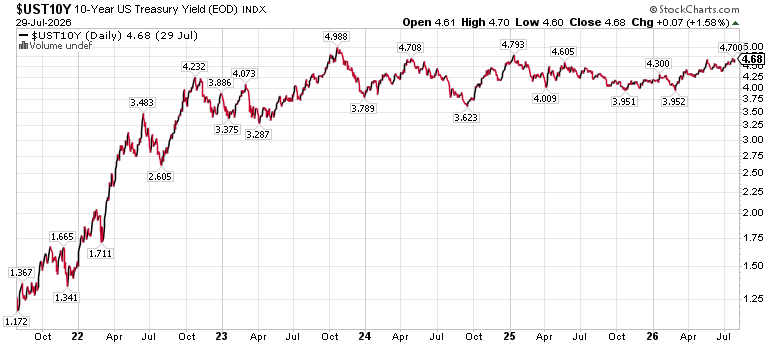
Looking at the 10-year rate over the last 5 years shows it has been chopping sideways for going on almost 3 years after peaking around 5% in late 2023. The 5% level seems to be important to watch as the rate has held below that in prior peaks over the last few years. A break above that level would seem to suggest bad news for markets and inflation.
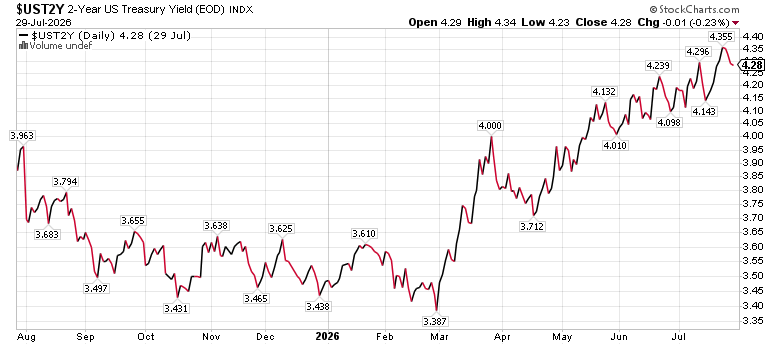
Another interest rate to watch is the 2-year treasury rate. It has had a history of telegraphing the Fed’s next move and where the Fed’s benchmark rate will eventually end up. Currently it is near 4.3% and like other interest rates has been trending higher for much of this year. The current Fed benchmark interest rate is set at a target of 3.5%-3.75%. Unless we see a sudden drop in rates it is more likely than not that we will see the Fed’s benchmark interest rate closer to 4.25% by the end of the year.
If the Fed does begin to raise their benchmark interest rate, it doesn’t mean rates across the board will have to keep moving higher. In fact, it is more likely that rates on the long end of the curve would settle and move down as the Fed begins to act. Much like in 2024 when the Fed would cut rates, the 10-year Treasury rate did the opposite and moved higher.
In my May newsletter, I highlighted the big advance semiconductor stocks had made and the similarities it had to the final advance before the tech bubble popped in 2000. The semiconductor index peaked in mid-June and has since had a rapid unwind. While the peak drawdown so far in the semiconductor index is over 28%, many individual semiconductor stocks and A.I. related stocks have seen declines of well over 50%-60%.
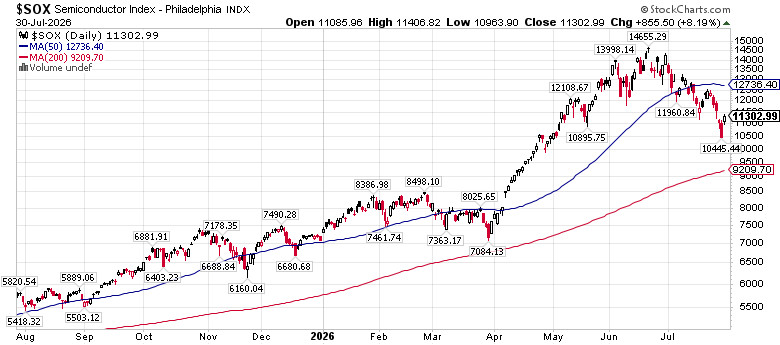
Looking at the semiconductor index above, though, shows it still has room above its 200-day moving average. A drop down to that level actually puts it back into the range of the trend it was on prior to April. In an ideal world that’s where it would find support and begin to trend higher at a more reasonable pace like we saw prior to April. But we’ve seen from all types of investments before when something overshoots to the upside, it typically will overshoot to the downside when it turns. This can be caused by the massive amount of leverage investors used on the way up. People will borrow money to be able to make more, which works when their investment keeps going higher. But nothing grows to the sky. Now that these stocks are coming down those that had bought with leverage are seeing their losses multiply and are forced to sell.
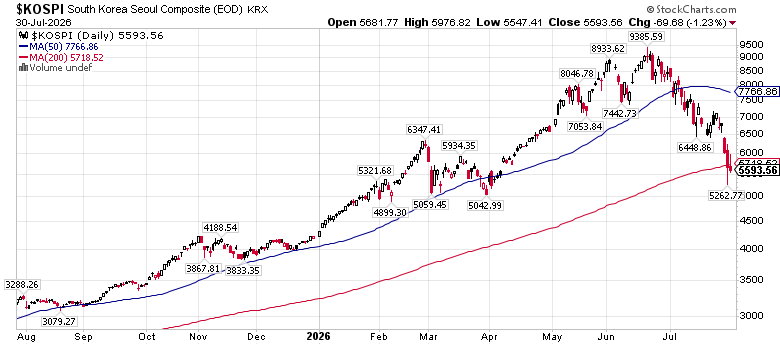
Speaking of leverage, one country, South Korea, has seen its stock index become almost a form of a casino. South Korea’s main stock index, KOSPI, is dominated by 2 tech stocks that have driven the performance of the index, Samsung and SK Hynix. Those 2 stocks alone have grown to make up over 50% of the index, which consists of 77 companies. Now that is heavy concentration! Those 2 stocks benefitted greatly from the run up in semiconductor and memory stocks with the A.I. buildout. Leverage again was used as those stocks kept reaching higher. But like the semiconductor stocks here in the U.S., those have been seeing an unwind as well, and even more so than what we’ve seen here. The chart below shows the KOSPI index, which has fallen almost 40% in just over a month.
There are always questions as you look out into the future. Right now, the question for semiconductors and A.I. stocks is whether the run is over. Is this just the first part of the unwind with much lower to go, or is it simply a break before its next major move? The positive so far for the U.S. indexes is that the unwind in these A.I. related stocks has not done major damage. The S&P 500 has remained in a consolidation pattern since the beginning of June. As money has rotated out of some of the high flying A.I. stocks, it has found a home in more value-based and defensive style stocks which has held up the indexes. As long as this continues and money stays in the market the indexes can remain elevated. For how long will remain the question if the semiconductor and A.I. stock unwind has further to go.
Cory McPherson is a financial planner and advisor, and President and CEO for ProActive Capital Management, Inc. He is a graduate of Kansas State University with a Bachelor of Science in Business Finance. Cory received his Retirement Income Certified Professional (RICP®) designation from The American College of Financial Services in 2017.
DISCLOSURE
ProActive Capital Management, Inc. (PCM”) is registered with the Securities and Exchange Commission. Such registration does not imply a certain level of skill or training.
The information or position herein may change from time to time without notice, and PCM has no obligation to update this material. The information herein has been provided for illustrative and informational purposes only and is not intended to serve as investment advice or as a recommendation for the purchase or sale of any security. The information herein is not specific to any individual's personal circumstances.
PCM does not provide tax or legal advice. To the extent that any material herein concerns tax or legal matters, such information is not intended to be solely relied upon nor used for the purpose of making tax and/or legal decisions without first seeking independent advice from a tax and/or legal professional.
All investments involve risk, including loss of principal invested. Past performance does not guarantee future performance. This commentary is prepared only for clients whose accounts are managed by our tactical management team at PCM. No strategy can guarantee a profit.
All investment strategies involve risk, including the risk of principal loss.
This commentary is designed to enhance our lines of communication and to provide you with timely, interesting, and thought-provoking information. You are invited and encouraged to respond with any questions or concerns you may have about your investments or just to keep us informed if your goals and objectives change.