

By Cory McPherson
June 26, 2026
2026 is shaping up to be one of the biggest years for IPO’s (initial public offerings) we’ve seen since the late 90’s tech bubble. The recent SpaceX IPO set records for size. Two of the most prominent A.I. companies are gearing up to go public later this year, OpenAI and Anthropic. In this newsletter, I’ll review some of the past hyped-up IPO’s and how they performed initially and why, historically, it has been best to remain patient when looking for an entry into some of these companies.
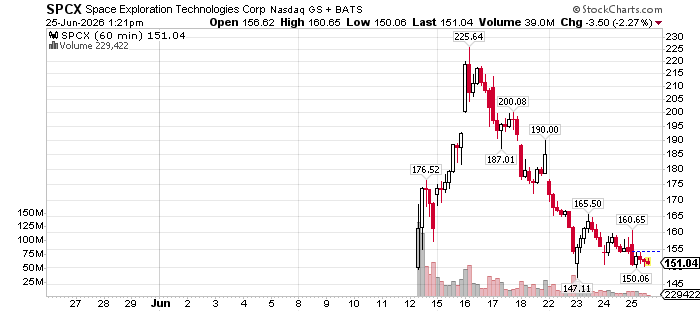
The recent SpaceX IPO raised over $75 billion, shattering the previous record IPO of Saudi Aramco in 2019, which had raised over $38 billion. Shares of SpaceX ended its first day of trading at $160.95/share, up over 19% from its IPO price of $135. After 1 day of trading, the market cap for SpaceX stood at over $2 trillion, making it the sixth-largest publicly traded US company on its first day of being public. A higher value than established companies like Walmart, Berkshire, and JP Morgan. After shooting straight up its first couple of days of trading, it has since come back down to where it was its first day of trading.
In looking at some of the biggest IPO’s over the past 15 years, the below chart from Truist shows while, initially, many IPO’s look great, they all eventually experienced a very large drawdown within their first year of trading. Many of them exhibit similar patterns with wild volatility in both directions. The median drawdown from these IPO’s is 54% within the first year. These were large IPO’s as well with large companies, but obviously SpaceX dwarfs them in amount raised and initial market cap.
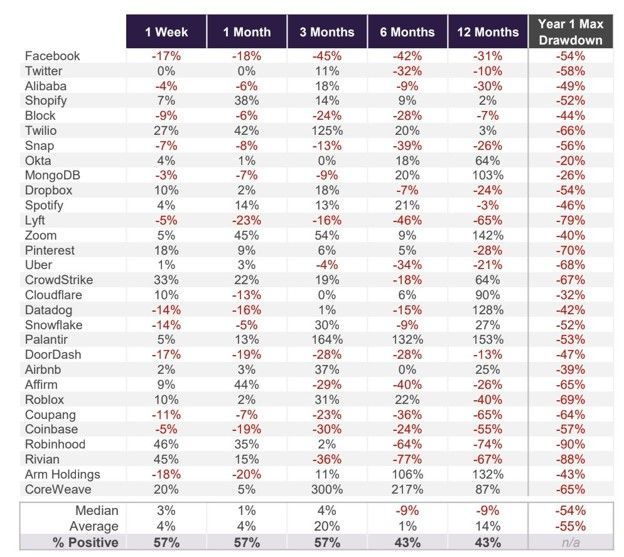
Now, it’s certainly possible SpaceX bucks the historical trend and does not see a large drawdown within its first year. But history tells us being patient with IPO’s is the best strategy. Relying on “this time is different” doesn’t work too often.
One thing to watch with its stock price over the next few months is when the lockup periods begin to end for SpaceX employees and early investors. It is a more unusual release schedule than other IPO’s of the past and is staggered over the next year. In August when SpaceX is expected to report its 2nd quarter earnings, an estimated 20% of restricted insider shares will be unlocked and able to be sold. That percentage could be 30% if shares are trading 30% above the IPO price. After that there are more staggered series of shares being unlocked and 180 days after the IPO date it is estimated 58% of the company’s total shares outstanding will be floated. The initial float size of shares stood at just 5% of outstanding shares. Company CEO and founder Elon Musk and other certain major stockholders are restricted for the full first year of trading from selling shares.
As more shares become available to be sold over the next few months it is expected to add to the volatility. Company insiders would be expected to start cashing in some of their stock when they are able, and as more shares become for sale, how the market is able to absorb that will be important to watch.
Along with the market needing to absorb more SpaceX shares, coming later this year we are expected to see two more large IPO’s. Both Anthropic and OpenAI are expected to go public in the fall or 4th quarter of this year. These AI companies are looking at valuations of $1 trillion or more. They will be looking to cash in on the euphoria and investing craze surrounding artificial intelligence.
The fundamentals for both of these AI companies, along with SpaceX, are not something value investors will look to. All of these operate at a loss, which isn’t necessarily uncommon for companies that have gone public over the last 10 years. But none have been at the staggering market caps initially that these will be at. Both OpenAI and Anthropic spend large sums on the ongoing build out of the AI infrastructure. It is believed that OpenAI operated at a net loss of over $35 billion last year and Anthropic at a net loss of around $10 billion. How these companies, along with the hyperscalers, are able to start profiting off of the large capital expenditures is the big question.
With the frenzied IPO market this year, it adds another element to the thought of whether or not we are in another tech bubble. There are many comparisons that can be made to the late 1990’s period. In our last newsletter we highlighted semiconductors and their recent performance in comparison to the late 1990’s. One chart that I found interesting recently is the performance dispersion in just the technology sector in 2026, shown below.
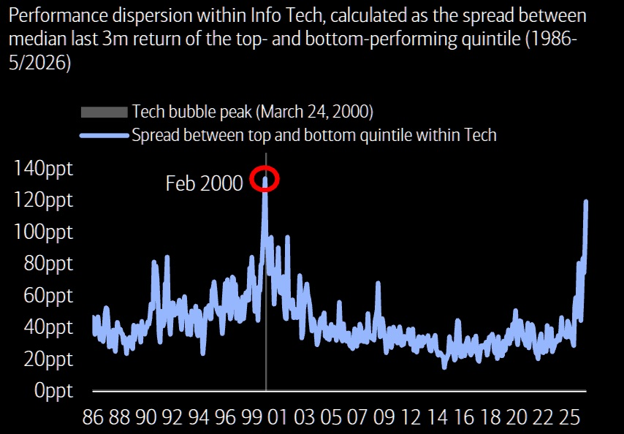
This shows the spread between the top and bottom performers in the technology sector looking back 3 months. It is at its widest dispersion since right before the peak of the previous tech bubble. While tech continues to drive the market, the sector itself has become very concentrated and has a lot of companies within it that are lagging. And it’s not concentrated in the mega cap tech stocks that everyone thinks about. Even those magnificent 7 tech stocks that have been the market leaders for several years now, have struggled in comparison to the tech sector itself that has been dominated by semiconductors.
As our great country celebrates its 250th year since our Declaration of Independence, we want to wish everyone a safe and happy 4th of July! Our office will be closed in observance on Friday, July 3rd.
Cory McPherson is a financial planner and advisor, and President and CEO for ProActive Capital Management, Inc. He is a graduate of Kansas State University with a Bachelor of Science in Business Finance. Cory received his Retirement Income Certified Professional (RICP®) designation from The American College of Financial Services in 2017.
DISCLOSURE
ProActive Capital Management, Inc. (PCM”) is registered with the Securities and Exchange Commission. Such registration does not imply a certain level of skill or training.
The information or position herein may change from time to time without notice, and PCM has no obligation to update this material. The information herein has been provided for illustrative and informational purposes only and is not intended to serve as investment advice or as a recommendation for the purchase or sale of any security. The information herein is not specific to any individual's personal circumstances.
PCM does not provide tax or legal advice. To the extent that any material herein concerns tax or legal matters, such information is not intended to be solely relied upon nor used for the purpose of making tax and/or legal decisions without first seeking independent advice from a tax and/or legal professional.
All investments involve risk, including loss of principal invested. Past performance does not guarantee future performance. This commentary is prepared only for clients whose accounts are managed by our tactical management team at PCM. No strategy can guarantee a profit.
All investment strategies involve risk, including the risk of principal loss.
This commentary is designed to enhance our lines of communication and to provide you with timely, interesting, and thought-provoking information. You are invited and encouraged to respond with any questions or concerns you may have about your investments or just to keep us informed if your goals and objectives change.