April 29, 2026

Rapid Rise
April 29, 2026

By Cory McPherson

April 29, 2026

After an almost 10% decline in March, the month of April has rewarded risk taking as the S&P 500 has shot back to all-time highs. While the market was due for a bounce, few expected such a rapid rise in the index. Was that the only market correction we’ll see in 2026? Looking at past mid-term election years and where we are in the long-term trend would suggest not. While price and the strength of this rally would suggest the possibility of a sustained uptrend similar to what we saw in 2025. In this newsletter, we’ll look at charts showing where we’re at in the S&P and the possibilities of what may come next.


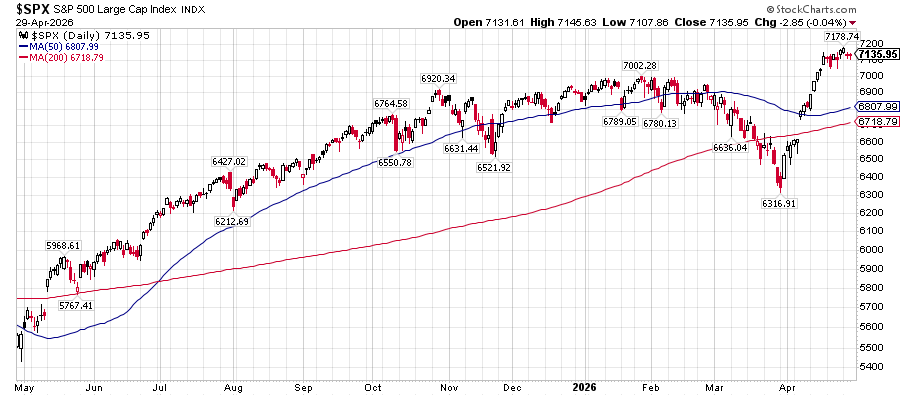
Looking at the 1-year chart on the S&P 500 below shows the bounce that started at the end of March. We then had a large gap up in early April after the ceasefire with Iran was announced and the rise continued after. At this point a pause would be healthy for the market to begin to gather enough strength for a continued uptrend.


What we would want to see happen for a continued uptrend would be a retest of the trading range we were in to start the year between 6800-7000. A successful retest and bounce would suggest this market still has legs and can continue marching higher. An increase in volume and breadth would also lend evidence of higher to go. So far, this rally has lacked a burst in volume that is typically seen in big advances like this. Amazingly though, over the 13 trading days that ended April 17th, the S&P 500 surged 12.3%. That is only the 10th time since 1950 that the index climbed that much in such a short period, even outpacing the quick recovery we saw a year ago after the tariff crash. Historically, rapid advances like this are seen during a bear market or after much bigger declines than what we saw in March, adding another abnormality to recent market action.


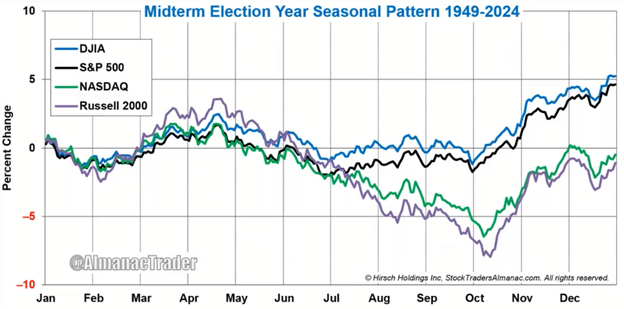
Looking at average mid-term election year, seasonal patterns show this is typically around the time when we begin to see market weakness. It then typically lasts into late summer/early fall before a more meaningful bottom may be put in. The following year after a mid-term year has historically been the strongest for the stock market. Obviously, it doesn’t have to play out like this, but it’s important to understand seasonality and how markets can often rhyme.


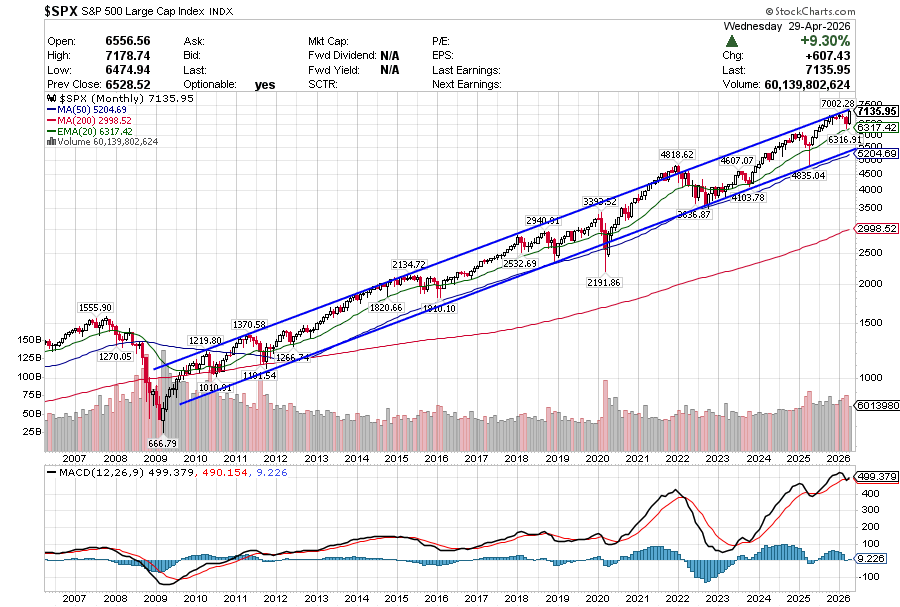
Looking at the long-term trend in the S&P 500 going back to 2009 when this secular bull market began also suggests the worst may not be over. At the end of last year, we were hugging up against the upper channel (blue) line where we’ve seen prior drops in the market occur from. Each of those drops since 2011 eventually came down near the bottom of the channel and the 50-month moving average. As you can see, the bottom in March remained well above that level. With this recent rally, the S&P has gotten right back up to the top of the channel.


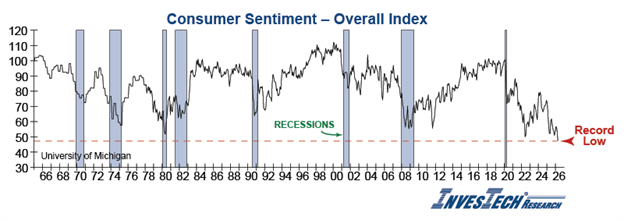
Another item that does not make sense in relation to the stock market being at all-time highs is the consumer sentiment index from the University of Michigan. Its April reading came in at all-time lows going back to 1951. 


Concerns about high prices in everyday life continue to be reflected in sentiment and confidence readings. Those concerns though have not caused investors to sell stocks. I believe it continues to reflect the two-tiered economy and separation of the haves and have-nots. High gas prices will also continue to weigh on how people feel about their situation and cause inflation readings to continue to tick higher in the near term. The national average gas price has climbed above $4/gallon and nears $4.20/gallon, an increase of about 45% this year. Going back to 1993, the average gasoline price topped $4/gallon in just 44 weeks, less than 3% of the time. Past periods of high gas prices have not been kind to the stock market, with the S&P 500 on average declining 11% during the following six-month period. Can the stock market continue to buck the trend of low sentiment readings and higher inflation expectations? Time will tell…


Cory McPherson is a financial planner and advisor, and President and CEO for ProActive Capital Management, Inc. He is a graduate of Kansas State University with a Bachelor of Science in Business Finance. Cory received his Retirement Income Certified Professional (RICP®) designation from The American College of Financial Services in 2017.


DISCLOSURE

ProActive Capital Management, Inc. (PCM”) is registered with the Securities and Exchange Commission. Such registration does not imply a certain level of skill or training.


The information or position herein may change from time to time without notice, and PCM has no obligation to update this material. The information herein has been provided for illustrative and informational purposes only and is not intended to serve as investment advice or as a recommendation for the purchase or sale of any security. The information herein is not specific to any individual's personal circumstances.


PCM does not provide tax or legal advice. To the extent that any material herein concerns tax or legal matters, such information is not intended to be solely relied upon nor used for the purpose of making tax and/or legal decisions without first seeking independent advice from a tax and/or legal professional.


All investments involve risk, including loss of principal invested. Past performance does not guarantee future performance. This commentary is prepared only for clients whose accounts are managed by our tactical management team at PCM. No strategy can guarantee a profit. 


All investment strategies involve risk, including the risk of principal loss.


This commentary is designed to enhance our lines of communication and to provide you with timely, interesting, and thought-provoking information. You are invited and encouraged to respond with any questions or concerns you may have about your investments or just to keep us informed if your goals and objectives change.


	wealth management services
April 9, 2026
Need wealth management services? Our team offers custom financial planning to grow your assets and secure a lasting multi-generational legacy.
By 7013838615 March 27, 2026
With bombs being dropped and missiles shot all over the Middle East, Americans here at home are fearful of what this conflict may turn into. This fear has obviously led to lower stock prices and much higher oil prices this month. Despite that, though, the selling that has occurred in the stock market so far has been co
wealth management advisor
March 10, 2026
Explore tips from a wealth management advisor that help investors remain calm, disciplined, and focused on long-term goals during market volatility.
Show More →