

By Cory McPherson
October 29, 2026
Without question, there is always uncertainty in markets and the economy. No one can predict what’s coming with any certainty. Lately though it seems there is more uncertainty now than what we’ve seen in recent history. You can point to multiple things that can have long-term ramifications on both markets and the economy that people just don’t know what to expect. From the effects of AI (and the massive spending happening) on everyday life and society, to the war in the Middle East, Ukraine, inflation expectations, interest rate moves, you could go on and on. A lot of these things tie together as well.
All this has put Americans in a sour mood as has been reflected in different surveys throughout the last few years. Consumer sentiment continues to make record lows as shown below in a chart from InvesTech Research.
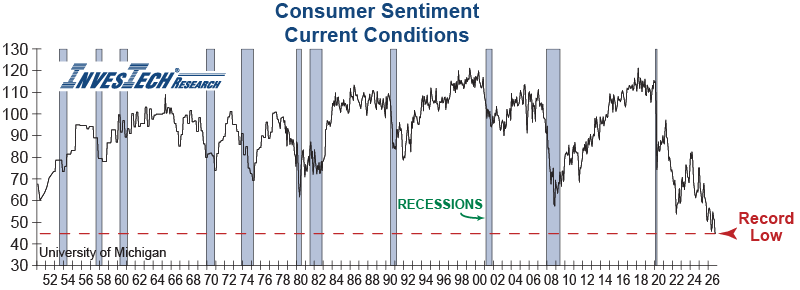
And yet, in a complete dichotomy to people feeling down on their current situation, consumer spending continues to increase! Real personal consumption expenditures increased at an annualized rate of 3.8% in the second quarter of 2026 and saw increases in July and August.
Are people actually better off than how they express themselves in these surveys? It’s hard to argue with someone about how they feel. I think a huge factor in the general negative sentiment on how people view things is driven by social media and just the general media we consume. Obviously, the general negative mood of the country has not been reflected in stock prices this year.
There’s also certainly a widening gap between the haves and have nots, with a segment of the population making up most of the consumer spending. It is also interesting to note that the U.S. economy is estimated to have grown at an annualized rate of over 3% in the third quarter, showing continued economic growth. At some point in the future, we will have economic contraction and a recession. Nobody knows when that will be but that’s just part of the normal economic cycle. With sentiment this low during a period of economic expansion and low unemployment, I’d hate to see what general sentiment is during a recession.
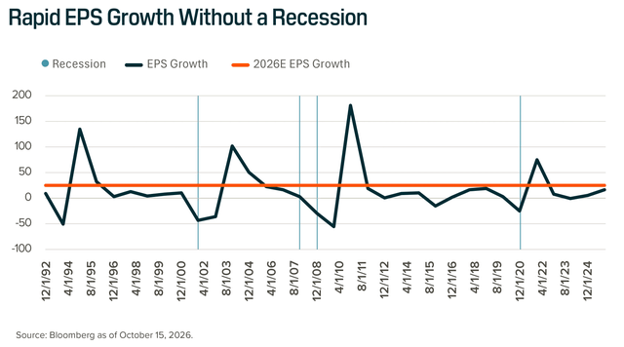
Negative sentiment also isn’t affecting corporate earnings. The fundamental backdrop in the market continues to look strong. We are in the middle of the third-quarter earnings season, and companies so far have delivered on fairly lofty expectations. Forecasts have called for 80% of the S&P 500 companies to deliver positive quarterly year-over-year earnings growth. 140 of those companies are expected to deliver earnings per share growth of over 30%. The chart below is interesting as it shows this year’s earnings growth with the orange line in comparison to earnings growth over time since the early 1990’s. The strongest year over year earnings growth periods happen when coming out of a recession. We are seeing strong growth for what we would consider to be mid-cycle that you typically only see when coming out of a recession.
A big part of what is driving earnings growth, and economic growth is the enormous spending happening with A.I. The hyperscalers that have been highlighted in past newsletters continue to spend heavily and have issued debt to continue spending. This adds to the uncertainty with A.I. as investors question how long these companies can continue to spend the way that they have before seeing some sort of return on that investment. A slowdown in spending, if it were to happen, then affects the earnings of companies downstream and overall growth in the economy. The fundamental picture would then change quickly.
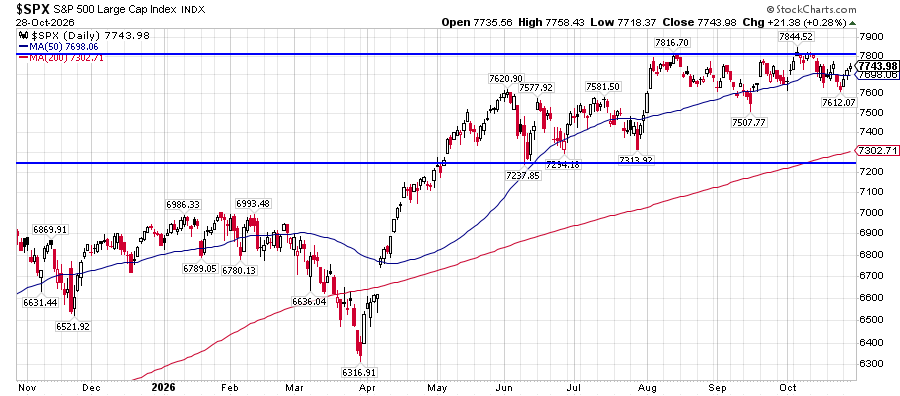
In my last newsletter I highlighted the choppiness seen in the stock market the last few months with rotation happening underneath the surface. That has continued in October and I believe just continues to highlight the overall mood of uncertainty and uneasiness that we’ve been in. The S&P 500 chart below shows the range we’ve been in since June. The positive is it has an upward bias to it and suggests that as long as we remain above the 7,200 area and 200-day moving average (red line) the bulls remain in control. Any period of selling we’ve seen the last few months just hasn’t sustained as money continues to rotate between different sectors of the market and keeping the index afloat.
One thing that will get settled soon is the midterm elections. Historically, the period of 5 days leading up to a midterm election to 3 days after the election is the best period for the stock market during a midterm year. Only once in the last 19 midterm election years has this period of time had a negative return (1994). This would favor the upward bias of the recent choppiness to continue for at least a little bit longer. While getting past the midterms takes care of one uncertainty, there’s still a lot of lingering issues the market will contend with through the end of the year and into 2027.
Cory McPherson is a financial planner and advisor, and President and CEO for ProActive Capital Management, Inc. He is a graduate of Kansas State University with a Bachelor of Science in Business Finance. Cory received his Retirement Income Certified Professional (RICP®) designation from The American College of Financial Services in 2017.
DISCLOSURE
ProActive Capital Management, Inc. (PCM”) is registered with the Securities and Exchange Commission. Such registration does not imply a certain level of skill or training.
The information or position herein may change from time to time without notice, and PCM has no obligation to update this material. The information herein has been provided for illustrative and informational purposes only and is not intended to serve as investment advice or as a recommendation for the purchase or sale of any security. The information herein is not specific to any individual's personal circumstances.
PCM does not provide tax or legal advice. To the extent that any material herein concerns tax or legal matters, such information is not intended to be solely relied upon nor used for the purpose of making tax and/or legal decisions without first seeking independent advice from a tax and/or legal professional.
All investments involve risk, including loss of principal invested. Past performance does not guarantee future performance. This commentary is prepared only for clients whose accounts are managed by our tactical management team at PCM. No strategy can guarantee a profit.
All investment strategies involve risk, including the risk of principal loss.
This commentary is designed to enhance our lines of communication and to provide you with timely, interesting, and thought-provoking information. You are invited and encouraged to respond with any questions or concerns you may have about your investments or just to keep us informed if your goals and objectives change.